
The Four Temptations
What Ngũgĩ and Mũgo Taught Me About Colonial Power

Background
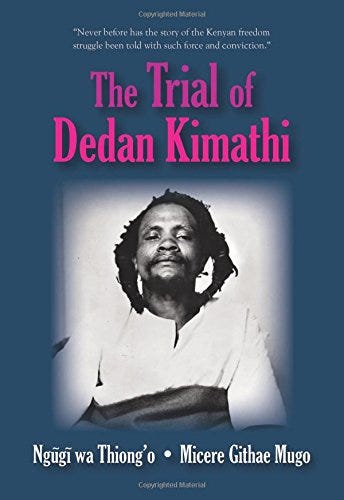
Back in the day, as a student at the University of Sussex, I took a small part in a production of The Trial of Dedan Kimathi. I cannot now recall which role I played. What I can recall, with considerably more precision, is the effect the play had on me - the sense of recognition it produced, the feeling that something I had known intuitively from growing up in the Caribbean had been given a rigorous dramatic form. Ngũgĩ wa Thiong’o and Micere Githae Mũgo had written a play that was not merely about Kenya. They had written a forensic anatomy of how colonial power works, and they had done it through the figure of a man who refused.
Dedan Kimathi was a field commander of the Kenya Land and Freedom Army - the movement the British colonial state branded the Mau Mau - and he was captured in 1956, tried, and hanged in 1957. The British administration understood precisely what his execution signalled: that organised African resistance to dispossession would be met with the full coercive force of the state. What they did not anticipate was that the manner of his refusal - his absolute unwillingness to betray his comrades or legitimate the system that condemned him - would outlast the gallows. Ngũgĩ and Mũgo dramatised that refusal. They placed Kimathi at the centre of a trial that is simultaneously a historical event, a philosophical confrontation, and a pedagogical text.
The structural device the playwrights employ is deceptively simple. Before the formal colonial court can deliver its verdict, Kimathi must survive a sequence of temptations - each one delivered by a representative figure of colonial authority. The dramatic logic mirrors the logic of colonial power itself: before it resorts to outright violence, the system tries to purchase your consent. It tries to make you a collaborator. Only when that fails does it reach for the whip.

The Banker
The first temptation is economic. A banker or businessman enters the cell and presents Kimathi with the ledger of colonialism - the roads, railways, trading posts, and salaried employment that British administration has, in this telling, delivered to Kenya. The argument is familiar: without us, there is nothing; with us, there is progress. The offer is personal comfort, a position within the system, a share of the prosperity that cooperation might yield. What Kimathi’s refusal exposes is the fundamental falsification at the heart of this argument. The infrastructure of colonial Kenya was not built for Kenyans. It was built to move extracted commodities to the coast and troops into the interior. The wealth that colonialism generates is not a gift; it is a conversion - African land and African labour transformed into European capital. To accept a salary within that system is not to benefit from progress; it is to participate in the ongoing dispossession of your own people. Individual material comfort purchased through complicity is not prosperity. It is a form of corruption.
The Cleric
The second temptation arrives in clerical robes. A missionary priest urges Kimathi to repent, to forgive his enemies, to understand his suffering as spiritually redemptive and to trust in divine justice rather than armed resistance. Turn the other cheek. God has a plan. Violence is sinful. What this scene stages is one of the most consequential political operations of the entire colonial period - the deployment of Christianity as a technology of pacification. The version of faith that colonial missionaries brought to Africa was not incidentally accommodating to colonial power; it was structurally designed to produce obedient subjects. Patience in suffering, deference to authority, acceptance of one’s earthly station - these were not peripheral features of missionary Christianity in colonial contexts; they were its political function. Kimathi does not reject spirituality. He rejects a God who has been placed in the service of the colonial state. There is a meaningful distinction between genuine faith and the weaponisation of faith to convince the oppressed that their liberation must wait for the afterlife.
The Politician
The third temptation is perhaps the most insidious because it speaks the language of progress and does not announce itself as collaboration. A Kenyan politician - a moderate, a constitutionalist, a man of reasonable argument - visits the cell to counsel patience. Independence is coming, he suggests. Negotiation is the path. Petitions, constitutional reform, the slow accumulation of concessions - these are the responsible instruments of change. The Mau Mau’s violence is extreme, counterproductive, alienating to potential allies. Wait. Be patient. Trust the process. What Kimathi’s refusal identifies is the structural function of gradualism within colonial politics. Gradual reform was not a route to liberation; it was a mechanism for managing resistance. Small concessions were offered precisely to absorb the energy that might otherwise fuel structural challenge. The moderate voice is not simply a voice of caution; it is a voice that asks the oppressed to negotiate from within a framework that the oppressor has designed and continues to control. Compromise from a position of fundamental powerlessness is not negotiation. It is, as Kimathi recognises, a sophisticated form of surrender.
The Whip
When all three fail, the fourth temptation dispenses with persuasion entirely. Judge Shaw Henderson - the representative face of the colonial state - applies torture. The logic is now undisguised: speak, name your comrades, and the pain stops; remain silent, and you will die in agony. This is not a temptation in the ideological sense of the earlier three; it is a physical confrontation between the state’s violence and one man’s will. But the playwrights are precise about what it reveals. Torture is not a sign of strength. It is an admission that every other instrument of control has failed. A confident colonial order does not need to break bodies; it governs through consent, habit, and the internalisation of its own legitimacy. When the state reaches for torture, it is confessing that it has lost the battle for hearts and minds, and that it now has only fear left to offer. Kimathi’s silence under these conditions is not a superhuman act of stoicism. It is the logical conclusion of everything that preceded it - a man who has already refused to be bought, pacified, or reasoned into submission, for whom the final question is simply whether the body can be made to betray what the mind has already decided.
Lesson Learnt
The overarching architecture of the play is what makes it more than agitprop. Ngũgĩ and Mũgo are not presenting Kimathi as a saint or a symbol. They are mapping the full operational logic of how colonial power seeks to reproduce itself. It works through four instruments - economic incentive, ideological pacification, political moderation, and physical coercion - in roughly that order, escalating as each fails. Any serious politics of liberation has to have an answer to all four. It is not enough to resist the whip if you have already been captured by the salary. It is not enough to resist the salary if the missionary has already convinced you that suffering is holy. It is not enough to resist the missionary if the moderate politician has persuaded you to wait indefinitely for change that will not come.
I did not fully understand all of this at Sussex. I understood it the way you understand something through your body before your mind has the vocabulary for it. What the production gave me was an experience of recognition - a sense that the structures I had grown up around in the Caribbean, the specific textures of post-colonial inequality and managed deference, had been named and dramatised with extraordinary precision by two Kenyan writers working from their own formation. The plantation and the settler colony are not identical institutions, but they share a grammar of power. Ngũgĩ and Mũgo wrote the grammar book.
Decades later, with considerably more theoretical equipment, I can say with confidence that The Trial of Dedan Kimathi is one of the most rigorous political texts produced in the postcolonial African literary tradition. It deserves to be read not as historical document but as a living analytical framework - one that asks, with uncomfortable directness, which of the four temptations you are currently being asked to accept, and what your answer will be.
Interning. It increases my temptation to read post-colonial works. Thank you very much.