
Net Migration Falls by 69%
Numbers, Narratives, and the Politics of Decline

Credit: Oxford University
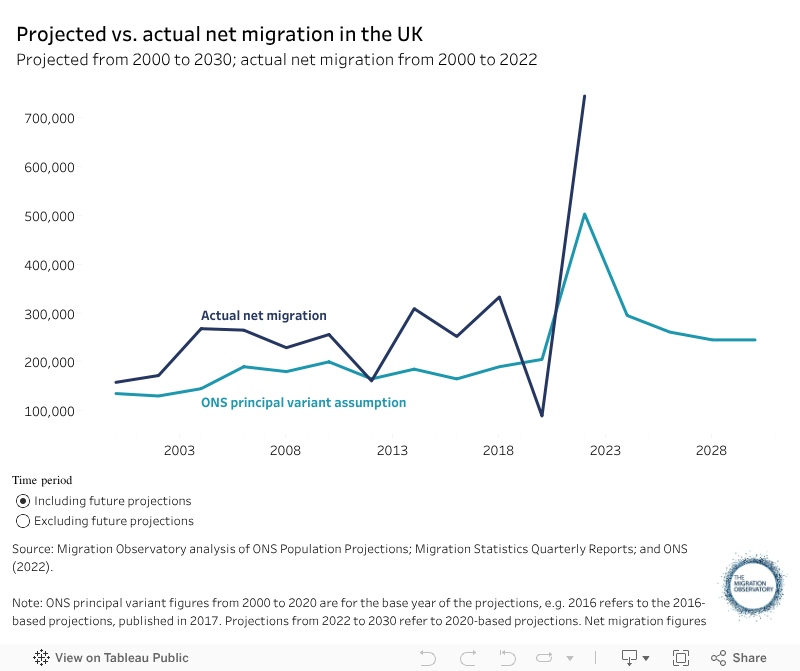
In the year to June 2025, UK net migration fell by 69%, dropping from 649,000 to 204,000. On paper, this looks like a political triumph - the promised “control” made real. But the headline is a spectacle that masks a more complex reality of policy tightening, labour market fragility, and statistical politics.
From Surge to Correction
This dramatic decline follows an equally dramatic surge. The peak of 944,000 in March 2023 was driven by unique, time-bound forces: post-pandemic demand, humanitarian visa schemes, and a buoyant international student market. The current drop is less a collapse than a correction—the deliberate unwinding of those exceptional inflows back toward pre-Brexit averages.
Labour Market Fallout
Behind the numbers, the consequences are tangible:
Health and social care: Recruitment pipelines have narrowed, leaving hospitals and care homes struggling to fill critical vacancies.
Hospitality and construction: Employers across these sectors report acute shortages as the inflow of migrant workers slows.
Universities: Stricter rules on student dependants have reshaped the international education landscape, with knock-on effects for local economies.
The central paradox is clear: migration has fallen, but the structural demand for migrant labour has not.
Housing and the Blunt Instrument of Statistics
While lower net migration may ease headline pressure on housing demand, it does little to address deep regional inequalities. London and the South East remain overheated, while towns that grew with migrant inflows now face economic contraction. This is the problem with the migration statistic itself; it is a blunt instrument that can obscure as much as it reveals.
The Politics of Control
The government will present this decline as proof that its controls are working. Yet this spectacle exists alongside a growing asylum backlog and more people in temporary accommodation than ever before. A falling net migration number offers political cover, but it does not resolve the deeper infrastructural crises in labour, housing, and welfare.
The Takeaway
The 69% fall is not just a number. It is a mirror held up to the UK’s political economy: a system that publicly celebrates statistical decline while struggling with a profound structural dependence. For anyone analysing this moment, the task is to move beyond the headline and ask the harder questions: What does this decline truly conceal? And what futures does it foreclose?