
Count Binface
What a man with a bin on his head reveals about British politics

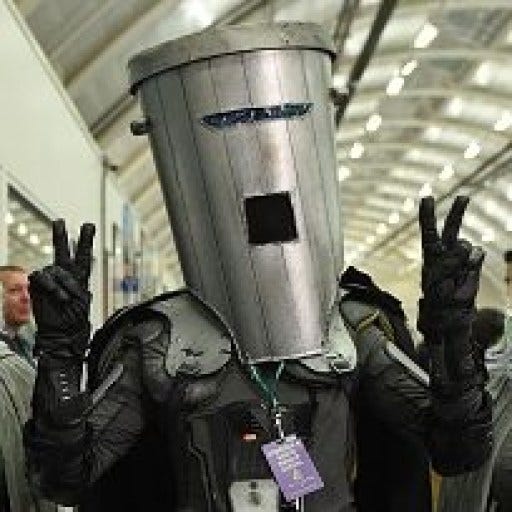
In a matter of a couple of weeks the Count has gained worldwide notoriety by declaring his intention to run for election in the Clacton by election against none other than Nigel Farage. Ive seen him covered in the US media, the Australian, Korean and Japanese media. So, he is now a global figure.
For those that don’t know, Count Binface is a self-declared “intergalactic space warrior.” I don’t remember when I first saw him, but he’s been a fixture in elections in the UK for maybe 20 years. When the returning officer announces results, he’s always there with the rest of the candidates with a metallic bin that extends from head to shoulders. This gives him extra height; you can’t miss him. Beneath the bin, Binface is Jon Harvey – a UK comedian. The Binface creation is part of a peculiar tradition in British political life that covers characters like Screaming Lord Sutch and the Monster Raving Loony Party. Together I think they say something about the role of humour in political life. They are disruptors, figures that pierce holes in the political process by calling attention to its absurdity. What sets him apart from his predecessors is the participatory, meme-driven ecosystem that has grown up around him.
Memetic politics
People who know about these things tell us that Binface is a part of memetic politics. People using politics to defray tensions and anxieties in the society through politics. They channel anxiety about cost of living and a political class they do not trust into a shared joke rather than a spoilt ballot or staying home.
The Count’s election manifesto pledges to:
· Cap the cost of croissants at £1.10
· Ensure that law breaking cyclists use unicycles
· Build one social affordable house
These are quite absurd on the face of it. But on another level, they point to real social tensions about the cost of living, transport and so on. If you like, the joke, is the vehicle for the complaint.
The point of the disruption is to build a counter narrative to the mainstream one. By doing so the election becomes a shared cultural event.
What does Binface tell us?
If we treat Binface as a diagnostic instrument, then I think he tells us something about the politics. British politics is like theatre, with photo ops and politicians increasingly relying on stunts (recall Boris Jonhson parachuting into somewhere and Ed Davey’s paddleboard, or his bungee jump). Binface just makes this explicit. This way he becomes a bit of a reflection for the political process.
Clacton by-election, 2026
By now everyone knows the story of the Clacton by election in 2026. Nigel Farage under investigation by Parliament for receiving dodgy money sought to derail that process by resigning his seat and putting himself up for re-election in the same seat. It was a take it to the people move, let the people decide. What Farage didn’t anticipate is that none of the other parties would take part in what they all thought was a distracting stunt.
So, the by-election slated for the 13th of August see’s Farage standing against 33 other candidates that include Laurence Fox, and the Monster Raving Loony Party’s “Howling Laud” Hope.
This has made the “counter-spectacle” literal. What it boils down to is Farage competing against a man with a bin on his head. I am betting that the Count cannot believe his good luck- the publicity has been astonishing. And when it comes to betting, to show how serious it has become, the bookies have shortened Binface’s very long odds that now make it a head-to-head (maybe more accurately, head-to binhead) betting markets between himself and Farage. The polls tell us that one in three members of the public would prefer a Binface victory. The absurdity is real.
Binface probably can’t believe his luck because Farage has unwittingly guaranteed him untold publicity and moreover he has presented us all with a sharp test of the memetic-disruption thesis. Disruption has become the campaign.
Rex - Binface is, thankfully, one of many ‘eccentric’ candidates in English by-election history. The capacity for ironic mockery of the system is almost built in with the openess of ‘democratic process’. I wonder how healthy it really is? Perhaps it stems from a public school tone of satire about the ruling class that I guess was set up deliberately to keep the status quo by lampooning its idiosyncracies. The decision taken by other established political parties not to stand against Farage gave Binface the opportunity to show a formal virtuosity about democracy linked loosely to a moral seriousness. Moments like this appear to swing from the gentle sideswipe to savage indignation of ‘what do you expect in such a system?’ to ‘it shouldn’t be allowed!’ If Binface wins, the response will be interesting …